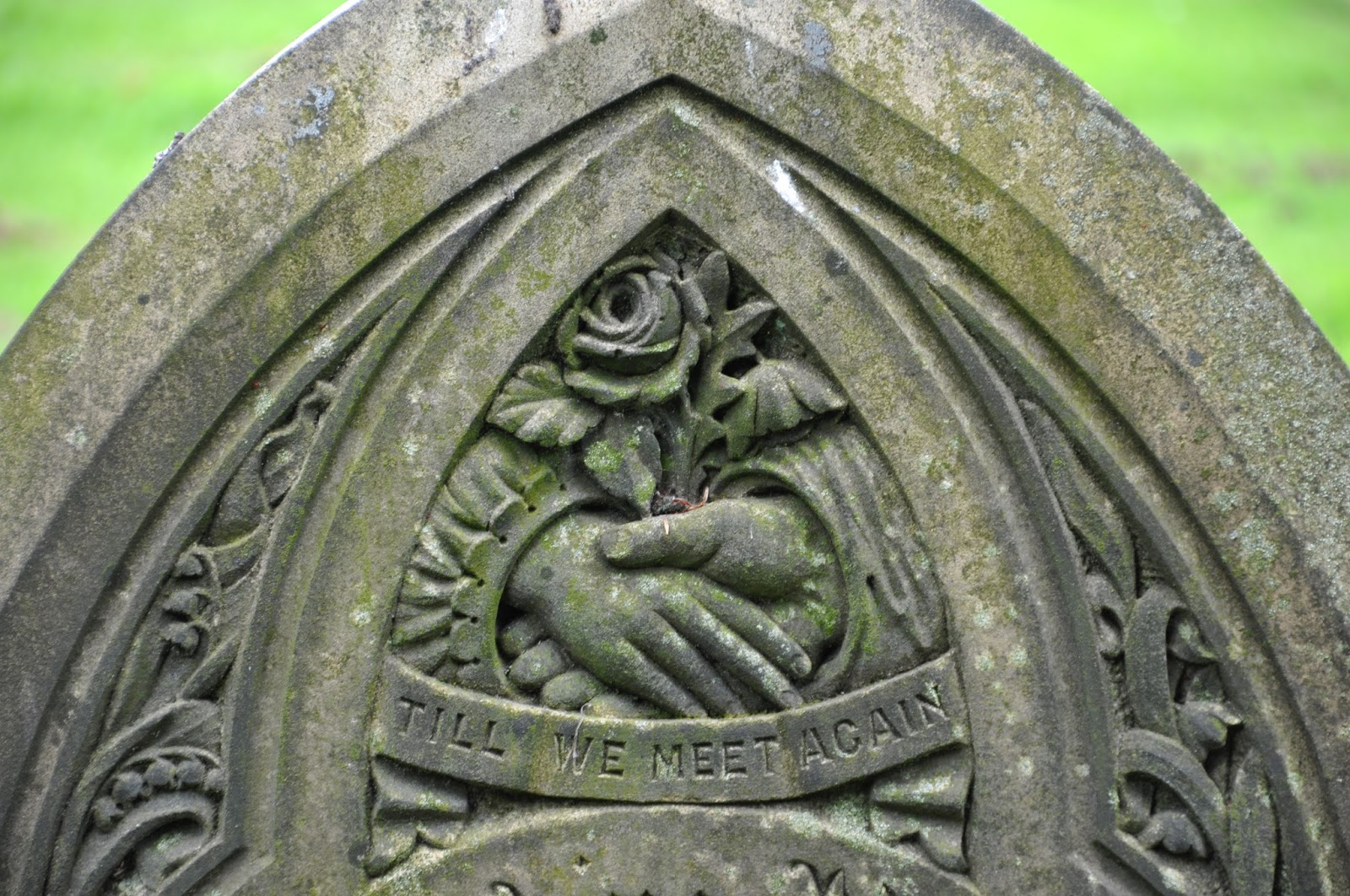
Wandering around Philips Park Cemetery in Manchester, recently, I came across some very fine examples of Grave Art and Symbolism on many of the headstones. They provide a lasting tribute to the skill of the stonemasons who worked on them, and whose names are often inscribed on the base of the reverse side of the stone. Here are several examples of Clasped Hands. This symbol has several meanings, including Farewell and Hope that those separated by the death will meet again in eternity.
Showing posts with label clasped hands. Show all posts
Monday, 16 June 2014
Friday, 27 May 2011
Variation on a Theme
On the south coast of England, one evening this week, I saw a sign to a cemetery and turned off my route to visit it. I was glad I did. It turned out to be an old cemetery with a host of interesting gravestones bearing some fine examples of grave art. I was captivated by this Ivy-clad headstone which marked the last resting place of Charlotte Ellen, wife of James Jilks, who died, aged 49, in 190?
I always record examples of clasped hands symbolism. I was fascinated to see this example supported on each side by a small angel. Has anyone seen anything similar?
Sunday, 14 March 2010
Keeping hold of a young child's Hand
I've posted before of the graveyard symbolism of putting a image of clasped hands on a gravestone. Here is an example I have not seen before. It depicts an adult hand holding that of a child. Richard Henry, beloved son of Richard Graveson and Mary Evans who died, aged 7 years and 3 months who died on 22 May, 1890.
Sunday, 23 August 2009
Hands clasped in Memory 2
Since my last post, I have revisted the folder of photographs taken in Fleetwood Cemetery and think I may have found two female hands clasped on a gravestone. The clothing on the wrist of the hand on the right is slightly worn, but sufficiently 'frilly' to look feminine. I compared it to others in the same cemetery and the only other variation from the jacket sleeve with shirt cuff bearing a cufflink was what seemed to be a knitted [perhaps Fairisle?] pullover sleeve. The latter being a popular item of clothing among males working in the then Fleetwood fishing fleet.

It is quite an interesting gravestone and besides, possibly, hiding some tragic event, it also demonstrates the potential for confusion when first read.
Robert C Stirzaker
Son of John and Mary Stirzaker
Who died February 28, 1893
Aged 24 years
Also Martha, Wife of Robert, the aforsesaid
Died April 6, 1893, aged 25 years
Also Daniel C Stirzaker, their son
Died October 3, 1893, aged 23 years
. . . . . .
Also the above John Stirzaker
Who died February 5, 1907
Aged 69 years
Also Mary Stirzaker
Wife of the Above
Who died May 31, 1911
Aged 72 years
Son of John and Mary Stirzaker
Who died February 28, 1893
Aged 24 years
Also Martha, Wife of Robert, the aforsesaid
Died April 6, 1893, aged 25 years
Also Daniel C Stirzaker, their son
Died October 3, 1893, aged 23 years
. . . . . .
Also the above John Stirzaker
Who died February 5, 1907
Aged 69 years
Also Mary Stirzaker
Wife of the Above
Who died May 31, 1911
Aged 72 years
Once we have worked out that Daniel is the son of John and Mary and not of Robert and Martha as the inscription seems to indicate - the confusion - we are left with the fact that a man, his wife and his brother died within a few months of each other.
I have not looked at Census Returns or Death Certificates, but Margeret Pangert is fond of inviting people to use their imagination to come up with a reason for something. So I'll start:
I immediately thought that illness might have been involved - husband and wife - and maybe the brother killed himself in grief. Then, I thought that, perhaps, the brother had an affair with the wife, the husband killed himself and the errant wife couldn't live with her guilt . . . Maybe, then, the guilt of unintentionally causing the deaths of the other two weighed heavily on his mind . . . ?
That's my thoughts, but my writers' imagination has probably worked overtime. What do you think happened?
I have not looked at Census Returns or Death Certificates, but Margeret Pangert is fond of inviting people to use their imagination to come up with a reason for something. So I'll start:
I immediately thought that illness might have been involved - husband and wife - and maybe the brother killed himself in grief. Then, I thought that, perhaps, the brother had an affair with the wife, the husband killed himself and the errant wife couldn't live with her guilt . . . Maybe, then, the guilt of unintentionally causing the deaths of the other two weighed heavily on his mind . . . ?
That's my thoughts, but my writers' imagination has probably worked overtime. What do you think happened?
Saturday, 22 August 2009
Hands clasped in Memory
The other day I was thinking about hands on gravestones, sometimes pointing heavenwards or sometimes clasped. The latter can be seen in profusion in Fleetwood Cemetery in Lancashire. As is the norm with the clasped hand symbolism, one hand is female, the other male. Has anyone ever seen two male hands or two female hands on a gravestone?
I was taken with the clasped hands on the stone pictured above this post. On occasion, as with this example, a finger points down to earth. I seem to remember it indicates a continuing connection with life on earth - perhaps with one partner surviving the other? What do others think?
Subscribe to:
Posts (Atom)
Welcome to the Graveyard Detective
An illustrated look at the World of Graveyards and Cemeteries. There are many Stories behind the Stones that Stand in them. Who knows what we might find?